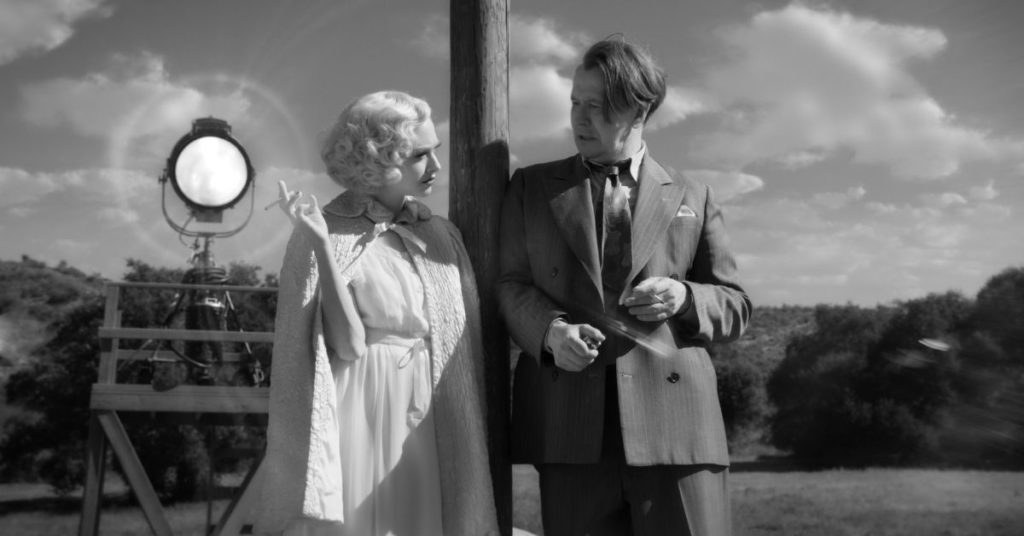
Famously heralded as the “greatest movie of all time”, Citizen Kane still stands as a masterclass of filmmaking. 80 years later and very few have been able to convey such an effective character piece. Directed by David Fincher, Mank takes us behind the scenes and accompanies the co-writer as he struggles to complete what would become his best work. Stylised within the aura of classic cinema, the film tells a story that doesn’t break any boundaries but is still incredibly delightful.
Touched on above, Mank follows alcoholic screenwriter Herman J. Mankiewicz, as he is given 60 days to complete the screenplay for Citizen Kane. The movie stars Gary Oldman in the title role, with a supporting cast that includes Amanda Seyfried, Lily Collins, Charles Dance and Tom Burke.
This is a picture proposing that the majority of Citizen Kane was written by Herman J. Mankiewicz instead of the credited collaboration with Orson Welles. As is the case with any movie based on real events, it is not the role of the director to tell a history lesson. It is only their job to tell an engaging story. Thankfully, this has been done exceedingly well.
A black and white affair that relishes in its neatly crafted dialogue (written by David Fincher’s late father, Jack), the result must first be commended for its efficiency. A writer’s life may be expected to be unexciting to many, but the use of flashbacks in this narrative allows for the display of a deeply layered individual. Gary Oldman is as impressive as ever, delivering a performance that, thankfully, doesn’t overstep its mark like many biopic leads tend to do. Recognition must also be given to Tom Burke, who is remarkable as Orson Welles (for the few scenes that he is in). His acting is absolutely perfect for the young, confident director, and his voice is undoubtedly spot-on as well.
Lovers of cinema will likely adore the experience offered. This window into 1930s Hollywood is mesmerising and impactful, while still recognising the shortfalls of the time period. However, beyond these points, the film doesn’t do much more than what you would expect. Although it is nice to see Fincher expand beyond his regular genres, Mank is a picture that could have probably been directed just as well by someone else. In fact, with another creator at the helm, perhaps we wouldn’t have had the movie’s biggest flaw, its political subplot.
Integrated into the overarching script of this film is a side-story that depicts a real-life election race between a Republican and a Democrat. The purpose of this addition seems to be to add some moral complexion to Mankiewicz as he chooses to oppose the Hollywood system. Unfortunately, these sequences just come across as distracting. The filmmakers seem to be making a comparison to modern politics but fail to do it with the nuance needed. It is not a huge hindrance but is big enough to worth mentioning.
As indicated, the style of this movie is certainly beautiful. Honest care has clearly been put into the visuals. For this, Erik Messerschmidt must be congratulated for his cinematography. Supporting this is a tremendous score by Trent Reznor and Atticus Ross. Using only period-authentic instruments, they have written music that is best described as simply faultless.
With Mank, David Fincher has added another quality release to his filmography. While it is not one of his best, the movie is still terrifically made and extremely enjoyable. This is an example of a story that delivers exactly what it wants to be. As a film fan, what more can you truly ask for?